What is FTP, how do you test it and why does it matter?
6 min readUpdated:
FTP (functional threshold power) is the highest average power a cyclist can sustain for roughly an hour, expressed in watts. It is the anchor of power-based training zones: every target, from an easy spin to hard intervals, is defined relative to FTP. That is why an accurate, current FTP is the precondition for a plan that pitches intensity correctly.
In this guide
What exactly does FTP measure?
FTP is a practical estimate of the point up to which your body can produce energy largely aerobically without fatigue piling up. Below it you can keep pedalling for a long time; above it fatigue builds quickly and the effort becomes unsustainable within minutes. The "one hour" definition is approximate: experienced riders can often hold threshold for longer, newer riders for less.
FTP is less a performance grade than a unit of measurement. It puts your own power on a scale. For a rider with an FTP of 200 watts, 150 watts might be a comfortable endurance ride, while for a rider with an FTP of 140 watts those same 150 watts are above threshold. That is what lets one workout deliver the right dose to both.
Why watts per kilo says more than raw watts
Raw FTP tells you how much power you can produce on the flat, but on a climb it is power per kilogram that decides things. Watts per kilo is FTP divided by body weight. A rider with an FTP of 250 watts who weighs 70 kg sits at about 3.6 W/kg. A rider of 85 kg with 280 watts produces more power on the flat but, at about 3.3 W/kg, falls behind uphill.
Watts per kilo is useful for comparing riders of different sizes and for tracking your own progress. Turning it into a weight-loss target can backfire, though: under-fuelling hurts recovery, immunity and, over time, power itself. If you are thinking about changing your body weight or diet, the right move is to discuss it with a health professional. For most amateurs, raising FTP is a safer and more lasting route than losing weight.
How do FTP tests work?
The most direct method is to ride flat out for an hour, but that is mentally brutal and too tiring to repeat often. So most common tests estimate one-hour power from a shorter maximal effort. Because you can produce more power over a shorter effort, the result is adjusted downwards. Step-by-step ramp tests work on a similar logic of estimation.
Whatever the test, the result depends on how you do it. A test done on tired legs, with a poor warm-up, or with a start that is too fast and then fades will come out below your real FTP. A good test is done on a rested day, under the same conditions, with an evenly paced effort. To compare results, use the same protocol each time and, where possible, the same power meter.
- Do not train hard the day before a test.
- Warm up properly, and keep the warm-up the same each time.
- Pace evenly: hold back in the first minutes and build towards the end.
- Avoid a maximal test close to a race.
Why indoor and outdoor FTP can differ
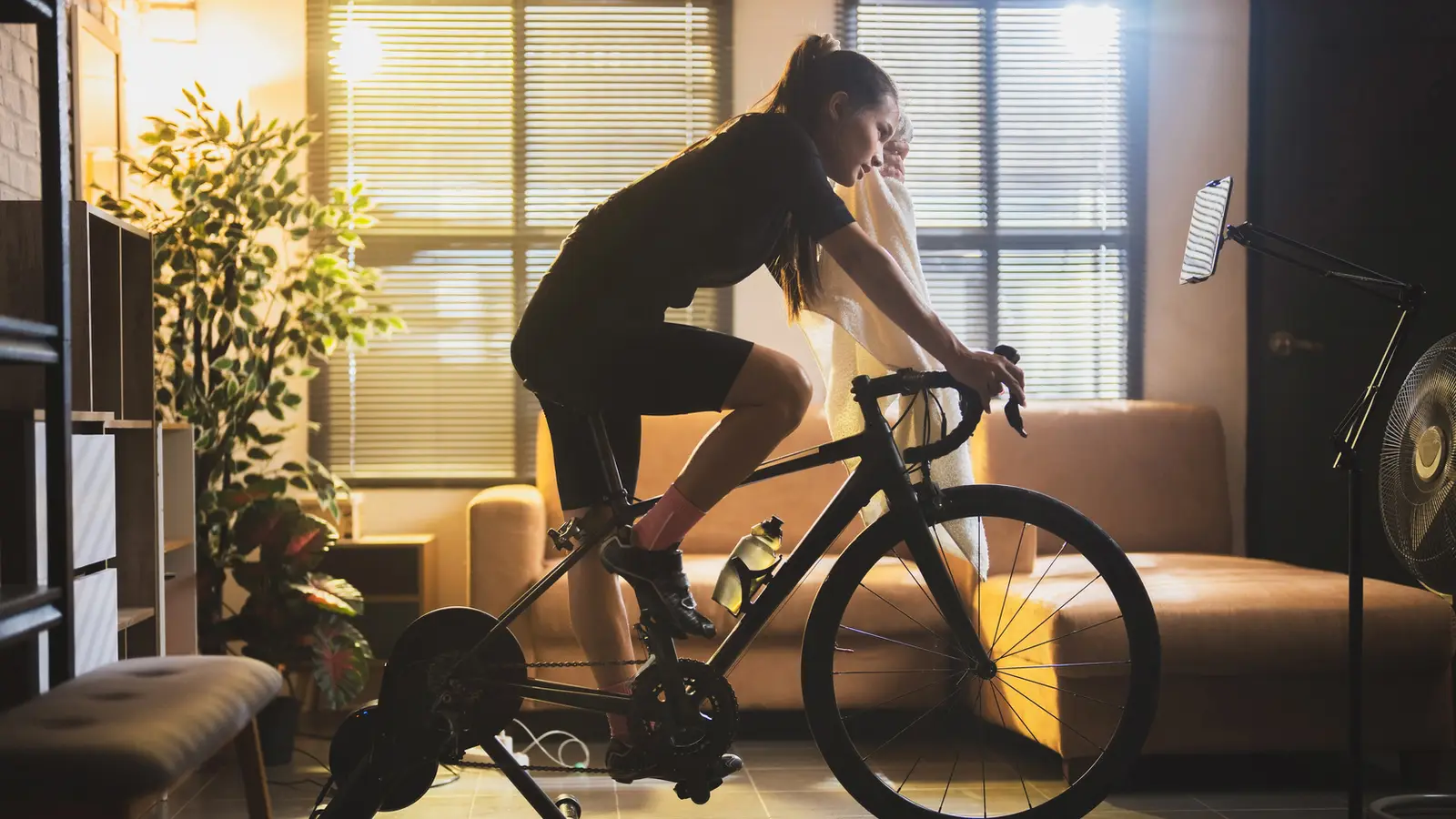
Many riders produce less power on a trainer than on the road. The reasons are familiar: indoors there is little airflow, so you heat up and heart rate climbs; the bike is fixed, which changes your pedalling rhythm and muscle use; and there is none of the resistance feel of climbing or riding into wind. The gap varies between riders, and some are even stronger indoors.
The practical answer is to test where you do most of your training. A strong fan indoors narrows the gap noticeably. A smart trainer and a power meter on the bike can also read a few watts apart; if you have both, pick one as your reference and judge your test by it. If you train regularly both indoors and out, keeping a separate value for each is also a sensible option.
Using FTP in Zwift, and its running equivalent
In Zwift workout files, power targets are defined as a fraction of FTP, and Zwift converts them to watts using the FTP in your account. In ERG mode the trainer then holds you to that wattage. So if the FTP in Zwift is out of date or guessed, a workout becomes either impossibly hard or uselessly easy. Whenever you retest, update the value in your Zwift profile too.
In running, threshold pace plays the same role: the fastest pace you could sustain for roughly an hour. Running zones are built from it and, as on the bike, refreshed by testing. In the pool, critical swim speed (CSS) serves as a similar anchor. In triathlon every sport has its own anchor; a high FTP on the bike tells you nothing directly about your run pace.
Frequently asked questions
There is no single "good" number; FTP varies widely with body weight, age, sex and training history. That is why comparisons usually use watts per kilo. What really matters, though, is not how you compare with others but how your own value changes over time. With consistent training at the right dose, FTP should rise over a period of months.
If you train consistently, testing every few months is a common approach. Test sooner if target wattages start to feel noticeably easy, if you are returning from a long break or if you have switched to a new power meter. Testing too often just adds fatigue; every test takes the place of a training day.
Not directly; FTP is a value measured in watts. Most smart trainers measure power, so an indoor test is one option. Without power data, guiding bike training by perceived effort (RPE) or by a measured threshold heart rate is a perfectly valid approach, and better than working from a guessed FTP.
It works as a rough starting point, but automatic estimates depend on what your rides contained; if you have not pushed at threshold for a sustained period, the number can sit above or below your real level. Because workouts are scaled to FTP, using a value from a controlled test is what makes the targets land correctly.
This guide is general information, not medical advice. If you have a health condition, an injury or pain that does not go away, see a health professional before you train.